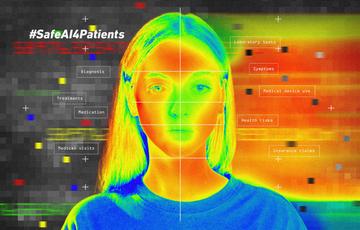
Artificial intelligence is finding its way into European hospitals. It helps analyse medical images, supports clinical decisions and is increasingly built into the software doctors and nurses use every day.
But there is a question that Europe’s AI ambitions rarely address: who actually controls the AI that enters our hospitals?
Who develops these systems? Who profits from them? Where does patients’ sensitive health data go? And do hospitals have enough information and control to make sure these technologies are safe, fair and respect people’s rights?
A new report, From Funding Rounds to Hospital Wards: The State of Health AI in the EU, by researcher Júlia Keserű in partnership with the Liberties network, examines how health AI is developed, funded, purchased and governed across the EU.
Its findings reveal a significant gap between the EU’s ambition to build a competitive and sovereign health AI sector and the reality of how these technologies reach hospitals. Uneven investment, dependence on a small number of technology providers and overlapping legal requirements are making it harder for hospitals to oversee AI and protect patients’ rights.
Here are six key findings.
1. Hospitals are responsible for AI they often cannot control
Hospitals increasingly acquire AI through medical equipment, electronic health record systems and software updates, rather than purchasing standalone AI products.
This creates an accountability problem. Hospitals are expected to oversee the technologies they use, but vendors may introduce or change AI features through updates, sometimes without providing hospitals with enough information or documentation to understand what has changed.
Public procurement data illustrates how difficult it is to track these technologies. Only 94 above-threshold EU procurement notices over three years explicitly mentioned AI. Of these, 72% were too vague to establish what the AI was intended to do.
If hospitals cannot identify which AI systems they use or understand how they work, meaningful oversight becomes difficult.
2. Health AI investment risks widening inequalities between EU countries
Investment in European health AI is highly concentrated geographically.
France is home to 14 of the 29 best-funded EU health AI companies and attracts 43% of their combined funding. Sweden accounts for another 31%, concentrated in just two companies.
Not one of these 29 leading companies is based in Central or Eastern Europe.
This concentration risks reinforcing existing inequalities between European health systems. Hospitals in countries with fewer domestic technology companies and less investment may become increasingly dependent on external providers, while having fewer opportunities to shape the technologies they adopt.
3. Patients' health data can leave hospitals through channels they barely understand
AI systems often rely on access to sensitive patient information. Data may be processed by external vendors, cloud providers or other technology partners, sometimes across complex supply chains.
There is another, less visible risk: so-called shadow AI.
Faced with heavy workloads, administrative demands and burnout, healthcare professionals may turn to publicly available generative AI tools to summarise medical records, draft documents or support everyday tasks. They may do so without hospital approval or a clear understanding of where the information they enter goes.
This can expose sensitive patient data to services that hospitals have not assessed or authorised.
At the same time, recent changes to the EU AI Act have weakened certain requirements concerning AI literacy training. This raises further questions about whether healthcare professionals receive the knowledge and support they need to use these tools responsibly.
4. Europe struggles to turn health AI innovation into a competitive market
Europe has ambitions to compete globally in AI, but its health AI companies face significant challenges in scaling up.
The gap with the United States is substantial. The US has:
- Five times as many health AI companies that have raised more than USD 50 million.
- Twenty times as many health AI unicorns (40 compared with just 2 in the EU).
- Nearly six times as much investment capital (USD 25.6 billion compared with USD 4.5 billion).
The EU's single market is also failing to deliver on its promise for health AI. Among EU vendors with explicitly AI-related hospital contracts, 96% sold their products in only one Member State.
This means that even companies developing promising technologies face significant barriers to expanding across European borders.
5. Public investment does not necessarily lead to public adoption
European institutions invest significant public money in developing health AI. But funding innovation does not automatically mean that hospitals will use the resulting technologies.
Between 2021 and 2025, only six of the 29 leading EU health AI companies received grants through Horizon Europe or the Digital Europe Programme.
And only one of these companies appears in the report's dataset of publicly advertised EU hospital contracts explicitly involving AI.
This raises an important question for policymakers: how can public investment translate into technologies that actually reach public hospitals and benefit patients?
Supporting the development of AI is only one part of the challenge. Europe also needs effective pathways for public institutions to assess, procure and adopt these technologies.
6. Overlapping EU rules can make protecting patients harder
The EU has introduced several laws intended to protect people as healthcare becomes increasingly digital. These include the General Data Protection Regulation (GDPR), the Medical Device Regulation, the AI Act and the European Health Data Space framework.
Each addresses important aspects of technology, data and patient protection. But hospitals must navigate these different requirements simultaneously, sometimes facing complex or overlapping obligations.
There can also be tensions between individual safeguards and broader public-interest goals. For example, data minimisation is an important privacy principle, but limiting the data available for analysis can make it harder to identify bias or assess how an AI system performs across different patient groups.
The challenge is not to weaken patient protections. It is to make sure that the different legal frameworks work together in practice and that hospitals have the resources, information and oversight needed to implement them.
Europe's health AI ambitions must put patients first
Europe's ambition to become a global leader in AI cannot be measured only by the number of start-ups it funds or the amount of investment it attracts. It must also be measured by whether the technologies entering public hospitals are safe, accountable and genuinely serve patients.
"Europe is investing in health AI and talking about technological sovereignty, but we need to look at who actually builds these systems, who controls them once they enter hospitals, and who benefits from the market they create," says lead researcher Júlia Keserű.
"Our findings suggest that Europe's challenge is not simply to develop more AI. It is to ensure that hospitals have meaningful control over the tools they use and that patients' rights remain protected as healthcare becomes increasingly digital."
Éva Simon, Head of Tech and Rights at Liberties, adds:
"European law gives patients important rights, but those rights are only meaningful if they can be exercised in practice. Hospitals must meet different requirements and navigate a legal maze. Policymakers need to understand the different layers of legal obligations, the gaps between them, and the resources, information and oversight hospitals actually have."
What comes next?
The report is part of a broader, cross-European research project examining the development and use of AI in healthcare.
It combines market and legal analysis with investment, procurement and grant data, 36 interviews involving more than 50 hospital AI experts, developers and practitioners, as well as academic and policy research.
The wider project also includes information requests sent to approximately 300 hospitals in nine EU countries, data access requests to major health AI companies in six countries, and correspondence with almost 400 developers.
Local organisations supporting the hospital information requests included partners in Belgium, the Czech Republic, Germany, Hungary, Italy, Malta, the Netherlands, Romania and Spain.
The findings will feed into a second report, due in January 2027, examining AI practices in hospitals and the implications for patients' data rights.
The research was supported by The Collaborative for AI in the Public Interest.
About the researcher
Júlia Keserű is a technology and society researcher whose work focuses on AI, health data and human rights. As a Senior Tech Policy Fellow at the Mozilla Foundation, she founded DataBody Futures, a research initiative exploring how health, biometric and other body-related data are collected, used and governed in the age of AI. She has two decades of experience in transparency, human rights and technology.
Related articles
Read the full report: From Funding Rounds to Hospital Wards: The State of Health AI in the EU
Interview with Julia Keseru: AI Health: “Who Does It Serve, and on Whose Terms?”
Safe AI For Patients: Building Accountability in Digital Healthcare